von Lingway Team
DeepL or AI Models for InDesign Translation: Which Should You Use?
There are now two kinds of machine translation you can plug into Adobe InDesign. One is a dedicated translation engine, with DeepL as the best-known example. The other is a general AI language model, such as ChatGPT, Gemini or Claude, asked to translate. Both produce fluent text. They behave differently, and the difference matters for layout work.
How they differ
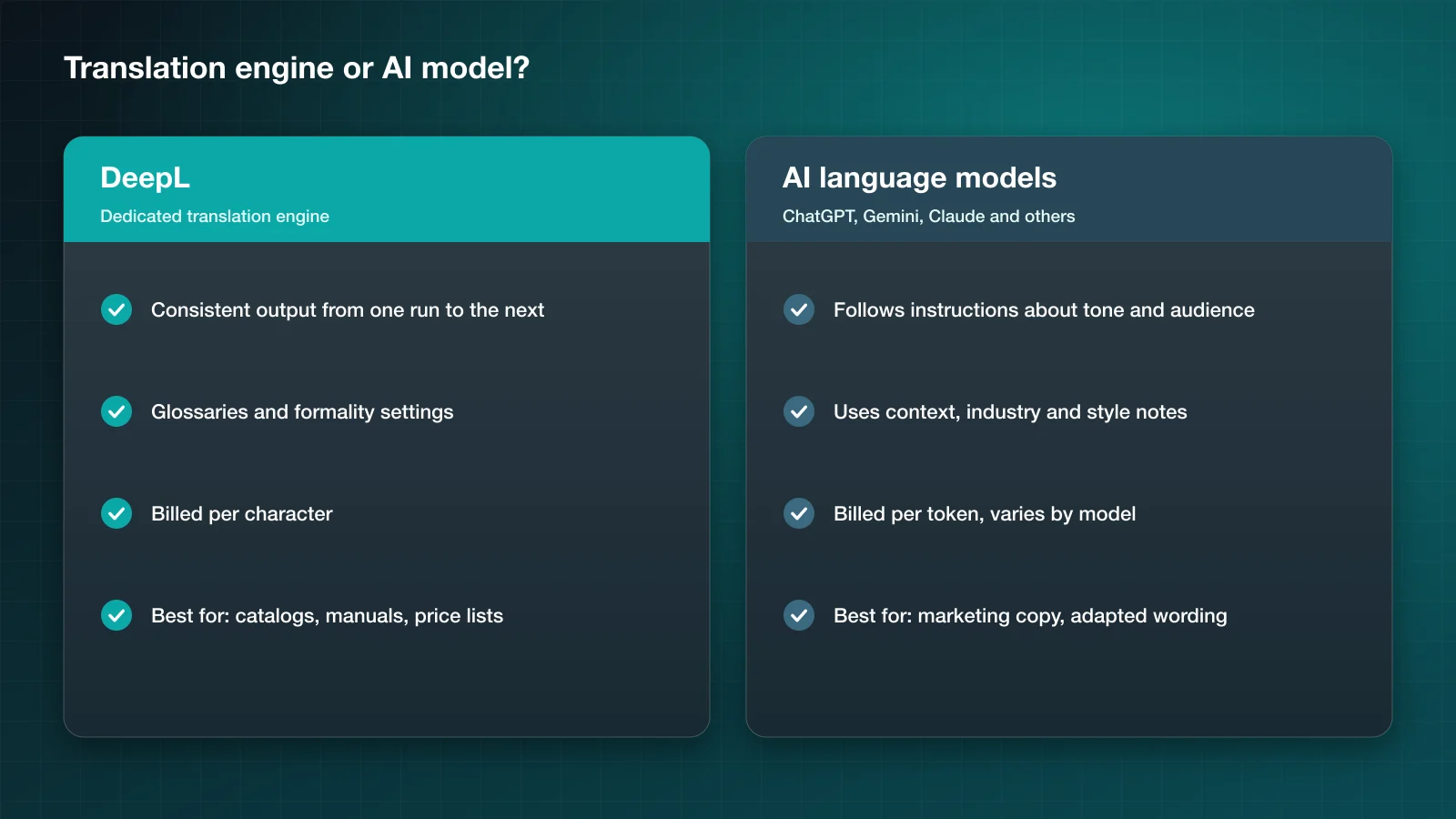
A translation engine is built for one job. You give it text, a source language and a target language, and it returns a translation. You steer it with a small number of settings: a glossary for fixed terms, a formality level, and optionally some context.
An AI language model follows instructions. Translation is one of many things it can do, and you describe what you want in words: the audience, the tone, the industry, what to leave untranslated, how long a headline may be.
Consistency
For a 200-page catalog, consistency is worth more than brilliance. The same product name must be translated the same way on every page.
- A translation engine with a glossary is predictable. The glossary is applied mechanically.
- An AI model can follow a glossary too, when it is given one, but it has more freedom and can vary its wording between runs.
If your content is repetitive and technical, such as specifications, price lists and manuals, predictability wins.
Control over tone
Marketing text is the opposite case. A slogan translated faithfully is often a bad slogan.
- A translation engine gives you formal or informal.
- An AI model accepts instructions like “write for retail customers, friendly, short sentences” or “this is a food magazine”. It can adapt the wording instead of mirroring it.
For brochures, campaigns and editorial content, that control is the main reason to choose an AI model.
Faithfulness
A translation engine stays close to the source. An AI model, asked to improve a text, may rephrase more than you wanted, merge sentences or drop a detail. In a layout this matters: a missing clause in a safety instruction is a real error. Keep instructions strict for technical content, and always review.
Cost
- DeepL API is billed per character. DeepL API Free includes 500,000 characters per month.
- AI models are billed per token, and prices vary a lot between models and providers.
For both, the cost of translating a typical brochure is small next to the cost of the designer’s time. Choose on quality and workflow first.
Privacy
Whichever you use, check where the text is processed and whether it is stored. Paid API plans generally come with stronger commitments than free consumer apps. For confidential documents, read the provider’s terms before you translate.
What matters equally for both
Neither approach fixes layout. After any machine translation of an InDesign document you still have to:
- fix overset text,
- check fonts and hyphenation for the new language,
- and have a native speaker read the result.
And both depend on how the text gets in and out of InDesign. Copy and paste loses formatting regardless of the engine. See how to translate an InDesign file with DeepL for the options.
Which to use, by document type
| Document | Better fit | Why |
|---|---|---|
| Product catalog, price list | DeepL with a glossary | Repetitive terms, consistency |
| Technical manual, data sheet | DeepL with a glossary | Faithful, predictable |
| Brochure, campaign, magazine | AI model with context | Tone and adaptation |
| Mixed marketing and technical | Either, with a glossary | Test both on a sample |
The honest answer is to test. Take two representative pages, translate them both ways, and let a native speaker judge without knowing which is which.
Using both in InDesign
We make a plugin for each approach, because customers asked for both:
- Translator PRO for Adobe InDesign uses DeepL, with glossaries and formality control.
- AI Translator PRO works with the AI provider you choose, using your own API key, and adds glossary, context and industry tone.
Both translate in place and keep paragraph styles, character formatting and layout.
Bottom line
Use a translation engine when the same thing must be said the same way every time. Use an AI model when how it is said matters as much as what is said. In both cases the translation is the quick part; the review and the layout are where the quality is decided.